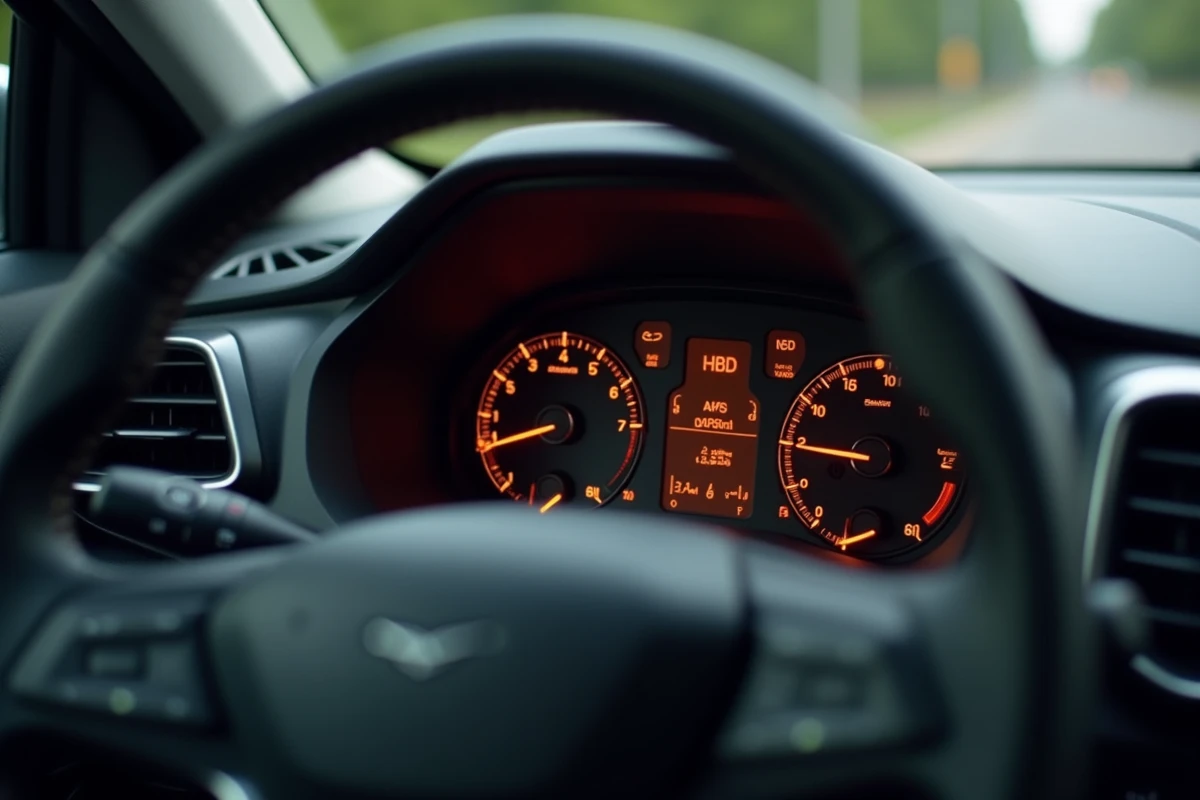
On the Peugeot 208 II, the digital display shows around forty icons, the hierarchical logic of which often escapes drivers accustomed to analog dials. Here, we detail the technical points that general public guides skim over, with a focus on the connected specifics post-2024.
i-Cockpit instrument cluster self-test protocol and ignition sequence
Upon contact, the 3D i-Cockpit cluster initiates a verification cycle of all indicators for about three seconds. This self-test is not cosmetic: it validates the operation of each LED or screen segment. An indicator that does not light up during this phase signals a fault in the cluster itself, not in the monitored system.
We recommend checking this sequence at least once a month, with the engine off and then on contact, visually counting the displayed icons. An indicator missing from the cycle (typically the airbag or ABS) should trigger a workshop visit for diagnosis of the multiplexed network.
To find a detailed list of Peugeot 208 indicators and their explanations, the technical documentation remains the reference, but it does not always cover the subtleties of the CAN network that drives the display.
On versions equipped with the 10-inch cluster (GT and Allure trims), the pixel matrix allows for the display of text messages in addition to the icon. The icon alone is no longer sufficient for diagnosis: the associated message specifies the severity and the course of action to take.

e-208 indicators vs. thermal 208: concrete differences
The most significant distinction concerns the management of the powertrain. On the thermal 208 (PureTech or BlueHDi), the orange engine light (MIL) is based on standard OBD-II codes. On the e-208, this indicator does not exist: it is replaced by a set of icons specific to the electric powertrain.
From 2025, the e-208 displays a specific “degraded battery” indicator, in the form of a flashing yellow battery icon, before switching to a red alert. This gradation has no equivalent on thermal models, where the transition from orange to red is often abrupt.
The reset procedure for this yellow battery indicator is exclusively through the MyPeugeot app, eliminating manual methods (disconnecting the 12V battery, generic OBD tool). This is a deliberate choice by Stellantis to channel diagnostics through the authorized network.
Indicators shared between electric and thermal versions
Some indicators remain common to both powertrains:
- The red oil pressure indicator only exists on thermal models. On the e-208, the cooling circuit of the electric motor uses a distinct temperature indicator, often confused with that of the conventional coolant.
- The ESP/ASR indicator (vehicle skidding icon) operates similarly, but the intervention thresholds differ: the instantaneous torque of the electric motor triggers the ESP more frequently on wet roads.
- The braking indicator combines on both versions the parking brake, fluid level, and system failure. Only the e-208 adds an active regeneration indicator.
Connected MyPeugeot indicators and failure anticipation post-2024
Since the software update deployed on the 208 II phase 2, several indicators are now coupled with push notifications via the MyPeugeot app. The vehicle transmits the status of its sensors in real-time to the Stellantis server, which analyzes trends and can trigger an alert on the smartphone even before the indicator lights up on the dashboard.
This functionality mainly concerns engine oil level, tire pressure, and the state of the high-voltage battery on the e-208. The app displays a history of alerts, allowing the mechanic to reconstruct the timeline of an intermittent fault.
Privacy limitations for the owner
This connectivity raises a rarely addressed issue. The transmitted data includes geolocation, real-time mileage, and driving habits (braking frequency, average engine speed). The owner cannot selectively disable the data transmission related to indicators without shutting down all connected services.
The European regulation (EU) 2025/1234, published in the Official Journal of the EU on December 15, 2025, now regulates access to vehicle data by manufacturers. It imposes a right of access for the owner to all transmitted data but does not yet require granular settings. In practice, on the 208, it’s all or nothing.

OBD diagnostics and reading indicators: what the generic tool does not see
An OBD-II reader costing less than fifty euros reads engine codes (P0xxx, P2xxx) on the thermal 208 without difficulty. The majority of orange indicators related to the powertrain thus find a quick explanation.
The limit appears on the multiplexed systems specific to Stellantis. Indicators related to the ESP, electric power steering, or the i-Cockpit cluster require a PSA-compatible tool (DiagBox, Lexia, or equivalent). A generic tool will display “no faults” while the indicator remains lit, causing confusion for the owner.
The Stellantis technical bulletin STLA-2025-045 (October 2025) documents a specific case: a false activation of the tire pressure indicator after a firmware update of the cluster, corrected only by recalibration via DiagBox. This type of software defect, invisible to a generic tool, is multiplying with the increasing complexity of onboard electronics.
According to the field study by the French Federation of Garages published in March 2026, a significant portion of workshop visits related to indicators concerns display faults rather than actual mechanical failures. On the 208 II, the line between hardware faults and software bugs in the cluster is blurring, and the reflex to plug in a basic OBD tool is no longer sufficient to make a decision.
The Peugeot 208 II illustrates the transition to a software-driven dashboard, where the indicator is no longer a simple binary switch but a link in a connected diagnostic chain. Mastering this logic avoids unnecessary workshop visits, provided one accepts that the appropriate reading tool is part of the basic equipment for the informed owner.