
From its inception, the automotive industry has been perceived as a male bastion, but over the decades, pioneering women have indelibly shaped this sector. Through roles as leaders, engineers, and designers, they have pushed boundaries and contributed to the evolution of the vehicles we know today. These influential women have not only enriched the automotive field with their expertise and innovation but have also paved the way for greater diversity and inclusion, transforming the industry from within and inspiring future generations to continue this momentum of change.
Pioneers of the Automotive Industry
The historical journey of women in the automotive industry reveals prominent figures whose contributions are etched into the very chassis of modern times. Bertha Benz, often overshadowed by her husband Karl Benz, is the first person to undertake a long-distance journey by automobile, thereby demonstrating the viability and endurance of the motor vehicle. Her bold journey contributed to the perseverance of the Mercedes-Benz brand, solidifying the automobile’s place in daily mobility.
Louise Sarazin, on the other hand, played a crucial role in the importation of the engine developed by Daimler and Maybach to France, forging trade agreements that enabled the democratization of the combustion engine and foreshadowing the birth of the first ‘true’ automobile. This entrepreneurial legacy is often overlooked, but it is essential in the genesis of the French automotive industry.
Inventiveness and innovation also characterize women’s contributions to vehicle safety and comfort. Mary Anderson, for example, designed the first manual windshield wiper, an invention that seems basic today but was revolutionary in its time. Dorothy Levitt, a pioneer of automobile driving for women, recommended the use of a rearview mirror and set a speed record, thus breaking stereotypes about women’s ability to master emerging technology.
Séverine Mény, although less known to the general public, embodies this generation of women who, like Florence Lawrence with her innovations such as turn signals or June McCarroll with the idea of the white line demarcation on roads, have helped shape an industry more attentive to safety and practicality. These women have thus laid the foundations for an automotive sector that today cannot ignore the necessity of inclusion and the valuing of diversity.
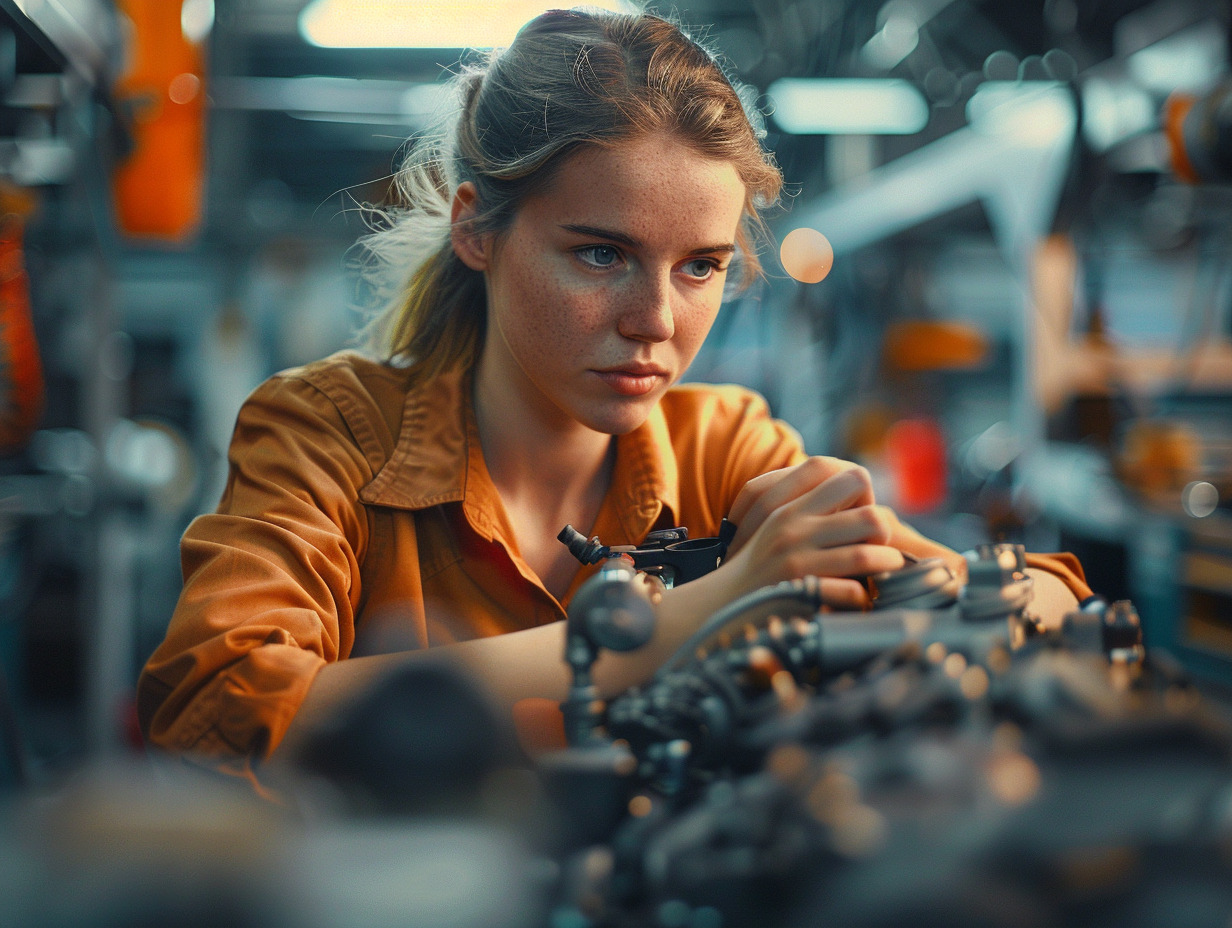
The Impact of Women in the Contemporary Automotive Sector
The female presence at the top of contemporary automotive companies is undeniable. Linda Jackson, the first woman to lead a French automotive brand, embodies this breakthrough in the glass ceiling. Her appointment as head of Citroën and, subsequently, her expanded global responsibility for the Peugeot brand within the Stellantis Group, reflects a cultural and structural evolution within industries traditionally dominated by male figures. The disruptive strategies and economic performance under her leadership validate the potential of female executives in a rapidly changing sector.
The impact of these advancements is not limited to individual cases; it resonates throughout the entire automotive ecosystem. The diversification of leadership leads to a healthy questioning of managerial norms and products. The heightened sensitivity to the expectations of a female audience and the consideration of diverse customer experiences are undeniable assets in designing more inclusive vehicles that cater to different lifestyles. The female contribution to innovation and design thus asserts itself as a vector of competitiveness and renewal.
The role of women in contemporary automotive also manifests through their influence in raising awareness of ecological and social issues. Their active participation in the transition to sustainable mobility and advocacy for diversity within companies are strong signals for the industry. They are at the forefront of the necessary transformations to meet the climatic, technological, and human challenges facing the automotive sector. Their voices and actions are shaping a future where mobility is more equitable, environmentally respectful, and open to all talents.