
Microsoft Azure is Microsoft’s public cloud platform. Discover everything you need to know about it: definition, features, use cases, pricing…
Cloud Computing is booming. Gradually, this technology is replacing on-premises infrastructure in businesses across all sectors. Its main advantage is that companies can access computing resources without having to invest in data centers or manage servers.
In 2018, this booming market is shared by four major players: Amazon Web Services, Microsoft Azure, Alibaba, and Google Cloud Platform. While Amazon is the undisputed leader in public cloud, Microsoft is gradually catching up with its Azure platform.
Microsoft Azure: what is it?
Launched in 2010, Azure is Microsoft’s cloud platform. It brings together various cloud computing services. It includes both open-source solutions and proprietary technologies from Microsoft or other companies. Originally, the platform was called Windows Azure. It was renamed Microsoft Azure in 2014.
Microsoft Azure: what is it used for?
Like other cloud service providers, Microsoft Azure allows leveraging on-demand cloud computing resources. It enables businesses to save significant costs by avoiding the construction of an on-premises data center, maintaining, updating, cooling, and paying for electricity.
This Cloud platform also simplifies the use and administration of Microsoft technologies such as Windows Server, Active Directory, and SharePoint. This allows IT teams to focus on other projects.
Furthermore, Microsoft plans to add AI features to it in the future. At the Microsoft Build 2018 conference, the Redmond company unveiled the integration of Project Brainwave (a deep learning system designed for real-time AI) with Azure.
Microsoft Azure: What are the different services?
Microsoft Azure brings together a variety of cloud services. Like its competitors, these services include storage services, virtual machines, and content delivery networks. Azure also offers services that leverage Microsoft’s proprietary technologies.
For example, RemoteApp allows Windows programs to be deployed on different operating systems via a virtual machine. Similarly, the platform brings together cloud versions of popular Microsoft enterprise solutions, such as Active Directory or SQL Server.
The other most popular services of Microsoft Azure include Azure IoT Suite for connecting and monitoring connected objects. This service also offers telemetry and analytics features.
HDInsight is a customized deployment of the Big Data Hadoop platform. Azure Cosmos DB is a hosted NoSQL database for specific use cases. Azure Media Services offers services for playback, indexing, transcoding, and protecting video content.
In total, Microsoft Azure offers more than 20 different service categories. In addition to computing, storage, web, and mobile development services, there are also integration, networking, containerization, and data analytics services.
The American giant also offers cloud services for emerging technologies such as artificial intelligence, blockchain, or mixed reality. Finally, many services are dedicated to managing the cloud itself and ensuring its security or migrating data to the cloud.
In addition to these services, Microsoft collaborates with hardware providers such as Lenovo, Dell, EMC, HP Enterprise, and Huawei to provide Azure Stack: a solution dedicated to hybrid cloud deployments. This allows organizations to use Azure cloud applications in combination with data hosted on-premises.
Microsoft Azure: Who uses Microsoft Cloud Platform?
In addition to companies that already use Microsoft technologies such as Windows Server and Active Directory, many are turning to Azure. Support for Windows Server ended in 2008, and migrating to the cloud can be more cost-effective than investing in a new server and a new Windows Server license.
This cloud solution is particularly attractive for small businesses that do not have enough capital for the hardware and associated costs of on-premises deployment or renting dedicated servers in a traditional data center. The Azure billing system gives them more flexibility.
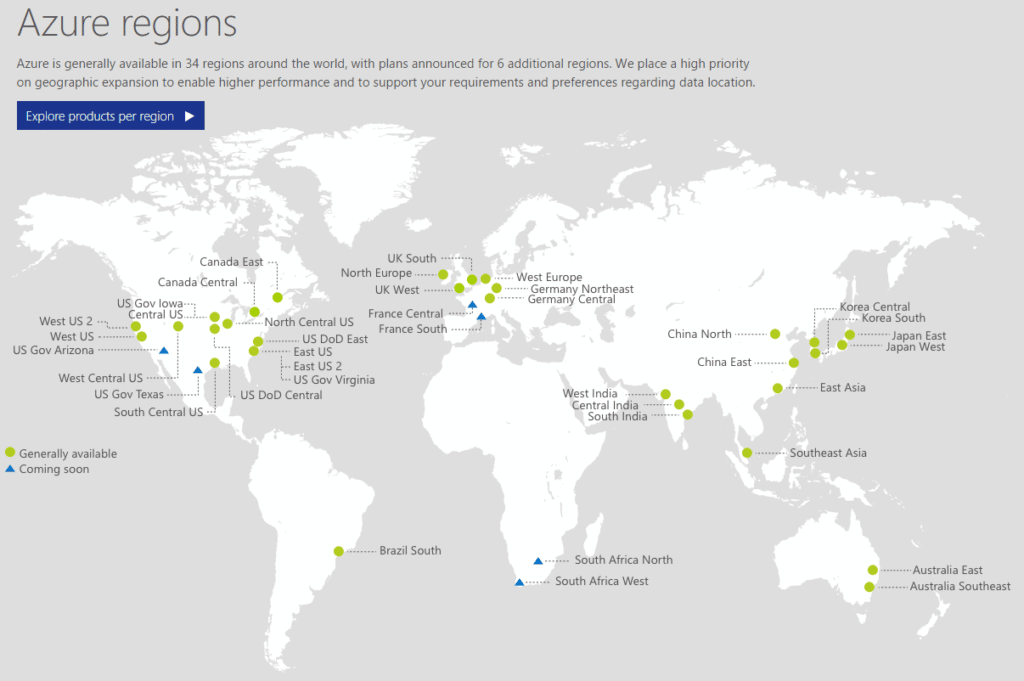
Currently, Azure is available in 50 different regions. Microsoft offers services in more emerging markets than its competitors AWS and Google Cloud: Asia-Pacific, South Africa, UAE…
Of the 50 regions, 16 are located in the United States, 2 in Canada, and 1 in Brazil. In Europe, four regions are located in Germany, and two in France, the United Kingdom, and Switzerland. Ireland and the Netherlands also have a region. There are four regions in Asia-Pacific, in China and Australia, three in India, two in South Korea and Japan, and one in Hong Kong and Singapore. South Africa and the United Arab Emirates each have two regions.
Microsoft Azure vs Google Cloud and Amazon Web Services
In the growing cloud computing market, Microsoft Azure is facing fierce competition from Amazon Web Services, Google Cloud, and IBM. Microsoft currently holds the second position in the global market, behind AWS and ahead of Google.
One of its strengths is the easy transition to the cloud for many businesses that already use Microsoft products on-premises. Cloud products are closely integrated with on-premises versions, making migration to the cloud easier.
Another advantage of Microsoft Azure is compliance with various regulations regarding data protection. For example, Azure is the first public cloud provider to receive FedRAMP certification in the United States or the Health Data Host certification in France. The latter gives it the right to store sensitive health data on its servers.
However, the market share is smaller than that of Amazon Web Services. Compared to Google Cloud, the Redmond giant falls short in areas such as machine learning, Big Data, or containerization…
Microsoft Azure: How much does it cost?
Instead of installing on-premises servers or renting physical servers in traditional data centers, Microsoft Azure provides customers with a consumption-based billing system.
Prices vary depending on the types of services and storage capacity used, as well as the physical location where Azure instances are hosted. For example, the price of storage varies based on the redundancy and distribution options you choose. Thus, businesses can save money by only paying for what they consume.
Note that the Microsoft for Startups program allows for $10,000 in Azure credits for one year. To take advantage of this offer, it is necessary to work with one of Microsoft’s 200 startup accelerator partners.
Similarly, the Azure program for students allows students to receive $100 in credits to use over a 12-month period. This program also provides access to 25 products such as virtual machines and Cloudstorage.
Tag: Training in MS Project