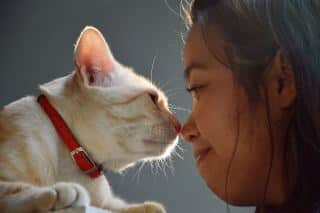
In recent years, pet health insurance has become a service that more and more cat owners are interested in to ensure the best care and comfort for their furry friends.
However, these insurances or mutual insurances continue to raise many questions about how they work for the uninitiated. Is feline health insurance worth the cost? Can you subscribe at any age? What type of coverage can we expect? How to choose it? A set of questions that our veterinarian will answer in this article to enlighten you and help you make your decision.
What does cat health insurance offer?
Pet health insurance, also known as animal health mutual insurance (but not really), is a coverage primarily aimed at cats and dogs, horses for certain offers, and sometimes for CNA (New Pets).
Just like a conventional insurance contract, the pet owner pays a monthly fee. In return, the insurer covers veterinary expenses up to the amount paid by determining the type of reimbursed care, the deductible per act, and the annual maximum payments.
Thus, a cat’s health insurance will range from simple accident coverage to more comprehensive coverage of all healthcare costs, medications, and preventive measures such as vaccinations. Quite logically, as the contribution increases, so does the coverage.
Among market players, cat health insurance has dominated the market for several years and now offers various plans tailored to the owner’s needs and their pet’s lifestyle.
Of course, they are not alone, and many competitors such as Assur’O Poil, Animaux Santé, AssurveTo, Sinon… also offer contracts to cover your kitty. 😉 Whatever provider you turn to, it is backed by a heavyweight in insurance that manages the coverage and guarantees related to your subscription. By reading the terms and conditions, you will find major insurance companies such as Generali, SwissLife, AXA, Allianz, Thelem, AG2R, etc… that guarantee thefinancial solidity of the services offered.
However, there are many questions you may have, and it is important to answer them so that your choice is as informed as possible. That is why we will address the most frequently asked questions by our veterinarians regarding feline health insurance in the rest of this article.

What you need to know about cat health mutuals
Here is a series of questions that you regularly ask us about your cats and kittens regarding pet health insurance and the answers provided by our veterinarian to help you understand the nuances of these benefits.
Do I really need insurance for my cat or kitten?
Most pet owners who take out health insurance for their cats first consider the amount of veterinary bills. The most common goal is to smooth out pet healthcare costs over time. In reality, it goes much further! When you choose to subscribe to a mutual fund for your cat, you are choosing to cover a risk and ensure that you can financially support the medical solutions offered when that risk becomes a reality. It’s a good way to give yourself a better chance of treating them well.
Do you need it? Perhaps not, because one cannot predict their cat’s accident, nor even know what illness they may suffer from. We also know from experience that cats often have accidents (road accidents, dog bites for those who go outside, falls from floors in apartments) and are regularly affected by conditions such as cat flu or urinary and kidney problems over time.
Your cat is no exception to the rule and if you are not sure that you will be able to incur significant veterinary expenses when the time comes or you do not want to have to make hard decisions about care for financial reasons, then insurance is for you. It is an investment, but also a way to remove the headache on the day the veterinarian offers advanced and costly care.
What does cat mutual insurance cover today?
As we explained in the preamble, brokers and insurers offer many options in terms of coverage. This will depend on the risk you want to anticipate.
For the first medical insurance policies for your cat or kitten, you can simply anticipate the risks associated with accidents, and these contracts are relatively inexpensive.
Then, you will be offered to scale up and cover health issues (illnesses, accidents, medications, and related complementary examinations).
Finally, wider protections also include preventive measures such as annual vaccinations, sterilization, food participation, etc.
The more open the umbrella, the higher the contribution amount, but the easier it is when it comes to paying the bill at the veterinary clinic.
How to find the most appropriate health insurance for my cat?
2 solutions are available to find your cat’s health insurer:
- Search yourself by contacting each company via its webpage and also rely on word of mouth and feedback from those around you.
- Use a cat mutual insurance comparator that will determine the best offers for your pet and show you the corresponding rates. It’s up to you to follow up or not after the simulation. You can try the one offered for free by Veto Tips via the previous link or the menu at the top of this page.
Can you take out medical insurance for your cat when it is already sick?
This is something to know and anticipate, insurers do not cover animals for which a serious or chronic condition has been diagnosed before subscription. The same goes for accidents! You will not insure your cat if it just fell from the 6th floor and is broken all over. The waiting periods serve this purpose: to prevent a clever little guy from trying to insure their bumper just when they are sick.
Some animals that have already had an accident or an old illness may be covered provided that these “claims” no longer cause symptoms and health problems at the time of subscription.
Is there an age limit to take out health insurance for felines?
Your kitten can be insured from a very young age as soon as it is weaned, identified, and vaccinated, and it is even recommended to start a contract while it is still young.
As for older animals, it is true that currently, very few insurers or brokers accept older animals. Generally aged over 8 to 11 years, refusal is common. Nevertheless, this is starting to change very slowly, and we do not lose hope of seeing providers come to insure older cats.
I adopted my cat and do not know its age. Am I eligible for pet insurance?
Don’t worry, before signing up, you will need to have a clinical consultation and , based on experience, the veterinarian will be able to estimate the age which will serve as a reference for the company’s insurance.

I do not have my cat’s medical history; can I still sign up?
Again, the visit to the veterinarian will determine your pet’s health status and the professional’s certificate will be taken into account by the insurance company to assess the care. When the animal is adopted after being in a shelter, its medical history at the shelter is also taken into account in the current assessment.
When does my cat’s insurance contract take effect?
The contract takes effect immediately upon signing, but you should ask before concluding what the waiting periods are.
The waiting period is a guarantee period during which the insurance does not cover claims. This period varies depending on the nature of the claim considered.
For example, a cat mutual may determine that accidents are only covered after 5 or 15 days and that illnesses are covered after 30, 15, or 45 days. This is a way for the insurer or broker to prevent “cheaters” from coming only when needed. If this happened too often, the system would collapse on its own.
It is therefore essential for you to know when your cat or kitten is actually covered if it suffers an accident or illness. Don’t forget to ask about it before signing.
What is the average cost of cat health insurance? How does the rate evolve?
As mentioned above, this will depend on the guarantees requested. The more guarantees there are, the higher the contribution. So, you need to do your calculations first.
To give ranges, we often find basic contracts of a few euros per month (8 to 9 euros) and premium contracts that can reach 50 or 60 euros per month.
Also note that it is rare for a contract to decrease over time. I encourage you to inquire about annual increase rates to budget your contributions.
Can a pet health insurance contract be easily canceled?
It is quite common for a cat or dog health mutual to commit you for a minimum of 1 year.
The common rule is tacit renewal, which is an automatic renewal of this contract as long as you do not cancel it.
You can, of course, cancel or interrupt a pet health insurance contract like any other insurance contract. This can be done within 14 days from a legal standpoint and at the end of the year preceding the due date if this service no longer suits you.
You will need to refer to the general sales conditions for the deadline and send your cancellation request in recorded form.
Am I allowed to take out 2 insurances for my cat?
Theoretically no, and quite frankly, it would be of no interest because risk coverage is not cumulative.
Just remember that cat health insurance is not a mutual like in human medicine. It does not provide for additional reimbursement after payment of health insurance.
Once this is included, paying twice for similar reimbursement is not interesting. Add to this that most contracts impose reimbursement deductibles (minimum non-reimbursed amount), and therefore you would be at a loss.
Is there a pet insurer that pays the veterinarian directly?
At the time of writing this article, third-party payment does not exist in veterinary medicine, so you will always have to advance the care before being reimbursed. This will require sending a care sheet filled out by your veterinarian, even if a digital mode is expected to develop in the future.
Third-party payment may come one day, but the complexity of standardizing such a process means it will not be seen immediately.
We hope these answers will help you better understand the cat health insurance contract you might receive and that your choice can be made in an informed manner if you subscribe to such a pet mutual contract. In the meantime, and to protect your cat or kitten from health problems and unwanted accidents, we recommend consulting Veto Tips and following our veterinary advice to keep them safe.
Tag: choosing a pet mutual