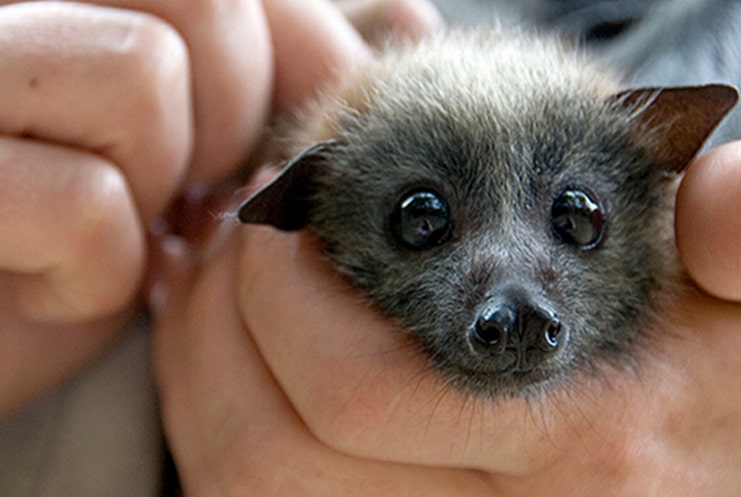
During the day they sleep and in winter they hibernate! Bats can be great sleepers. But did you know that they hibernate in groups and that there is a… vampire bat? Here are 6 curiosities about bats that are really interesting to discover!
1 — The vampire bat
The vampire bat (scientific name Desmodus rotundus) is a flying mammal found throughout America. Unlike other bats that primarily eat insects, it feeds on blood, particularly that of livestock, thanks to special nerve endings capable of sensing the heat of veins! Hence their name: “blood-sucking” vampires, precisely. In the absence of animals, they can attack humans and in this case, they are very dangerous because they can transmit rabies.
2 — The reddish bat
Among the many species of bats, the most common is the reddish bat: about eight centimeters long and with large ears, it is also widespread in the Italian countryside and cities. It feeds on insects that it hunts during the night.
3 — The giant bat
When we talk about the giant bat, we are referring to 130 species that make up the family Pteropodidae. They live in tropical regions of Africa, Australia, and the Polynesian islands. All are large and have thick fur. The largest of them is called the Malayan flying fox: it has a wingspan that can reach up to five feet! Imagine encountering one…
4 — Bat in English: bat
The English translation of “bat” is “bat”: the comic book Batman is actually also called “the bat man” (and his symbol is just this animal). Unlike Batman, the hero of good, bats have a rather negative connotation, associated with our fears and anxieties.
5 — Hibernation of bats
Both do, in fact, with the arrival of winter, they hibernate by taking refuge in caves, mines, abandoned buildings, or tree holes.
They fall into hibernation and wake up very quickly thanks to their high metabolic rates (that is, the “efficiency” of their body), but also because they live in poorly protected places and are subject to significant thermal and weather changes. I mean, they don’t sleep in a 4-star hotel!
The hibernation of bats is not immune to sudden awakenings! And if they are disturbed, they can also move several times during the winter. Their hibernation (like that of many other animals) begins with a decrease in heart rate, which slows down and remains steady at only 10 beats per minute! A good change if you think that, when fully active, it is very high: up to 600 (six hundred!) beats per minute.
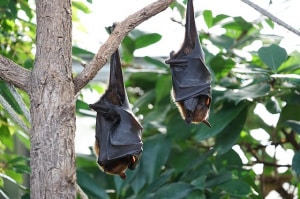
What makes the hibernation of bats extraordinary is the fact that it occurs as a group. In fact, in winter, in caves, we can find many bats sleeping together. However, this is not about the desire to stay in company, but rather a smart survival tactic: being close to each other, the temperature remains almost constant, it does not drop! Think about it: the patagium, the membrane that allows them to fly, is their fur. The internal temperature (that is, wrapped in the… layer) can vary by as much as 20 °C compared to the outside.
Like all other animals, even bats use the fat accumulated during the good season to stay alive during hibernation. Moreover, it is essential that these animals are not left without water upon waking.
Tag: bat in the house: tips