
On the ground, in geriatric services or nursing homes, nursing assistants are already performing tasks that go beyond the strict framework of their current reference. Endotracheal suctioning per protocol, application of compression stockings, monitoring of clinical parameters: these common practices await official recognition. The new nursing assistant reference planned for 2026 aims precisely to formalize these developments and redefine the scope of competencies in the profession.
Care actions under protocol: what changes concretely on a daily basis
The 2026 reference aims to clarify the framework within which nursing assistants can perform certain technical care actions under nursing protocol.
These actions, often already informally delegated within teams, would benefit from a more readable regulatory framework.
For teams, this clarification changes the game: the nursing assistant performing a technical care task has an enforceable traceability and a written protocol validated by the referring nurse. To better understand the changes in the new nursing assistant reference 2026, it is essential to distinguish between what falls under regulated cooperation and what remains the exclusive domain of the IDE.

Non-technical skills and patient safety: the underestimated axis of the 2026 reference
The ministerial roadmap 2026-2028 on patient safety emphasizes an aspect that professional discussions often overlook: non-technical skills. Communication within the team, early detection of clinical deterioration, stress management in emergency situations.
We are not talking about abstract theoretical modules here. In a night shift at a nursing home, knowing when to alert and how to convey a structured observation makes the difference between rapid care and a detrimental delay. The reference integrates these skills into initial training and into the expectations for skill updates.
Integration of new professionals in service
The ministerial roadmap also emphasizes supporting nursing assistants in their job placement. Feedback on this point varies by institution, but the observation remains shared: a poorly integrated professional in a team poses a risk to the safety of care.
The 2026 reference provides that training institutes strengthen preparation for real work situations. Internships in psychiatry and child health, made mandatory in the reformed nursing pathway, could also influence the internship placements offered to nursing assistants, even if no text yet confirms this for the DEAS.
Nursing assistant training and pathways to the state nursing diploma
The 2026 reference is part of a continuity logic between the two professions. The skills acquired by the nursing assistant are designed to align with the new nursing reference (decree of February 20, 2026). The stated objective: to allow for a recognition of blocks of competencies upon entry into IFSI.
The validation of acquired experience (VAE) remains an accessible mechanism for nursing assistants wishing to advance. The precise modalities of this articulation between DEAS and nursing training will depend on forthcoming regulatory texts.
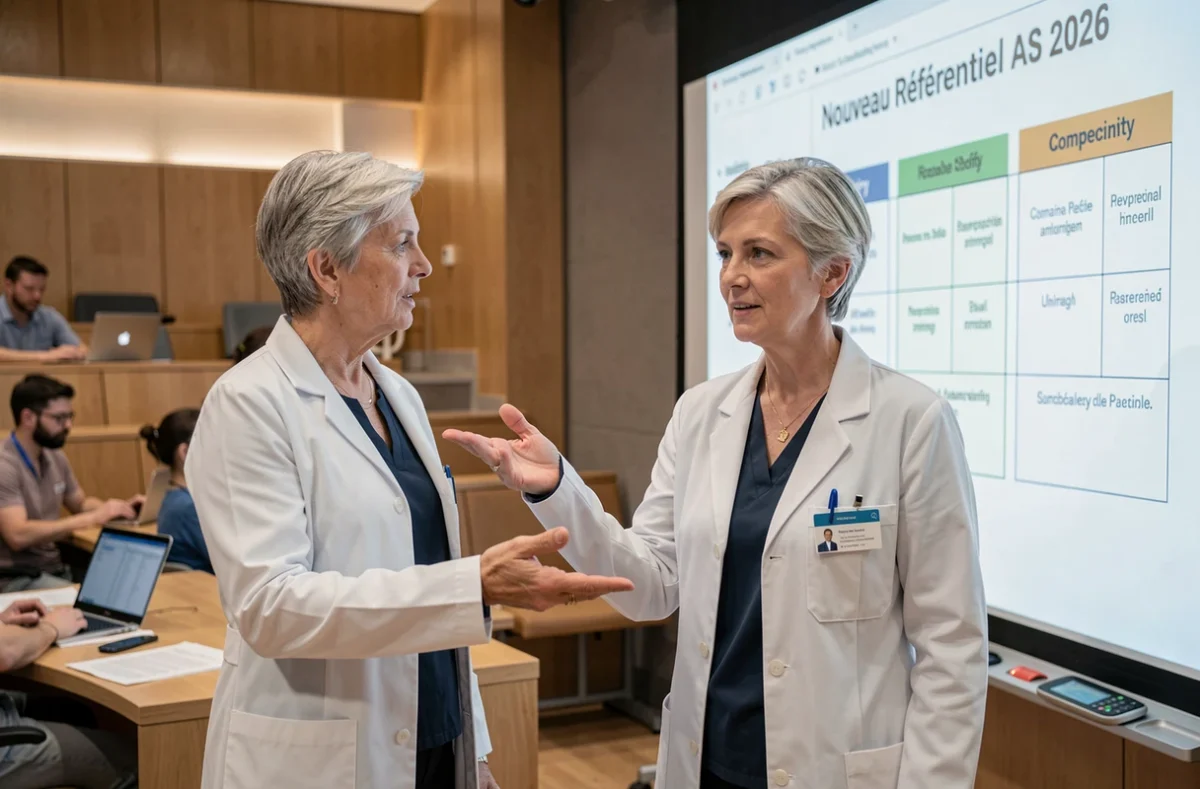
Nursing assistant reference 2026: distinguishing the confirmed from the probable
A point of vigilance is necessary. At this stage, no specific decree published in the Official Journal completely overhauls the nursing assistant reference as the decree of February 20, 2026 does for nurses. The expected developments for nursing assistants are based on the ministerial roadmap 2026-2028 and on the regulatory dynamics initiated since 2021.
Confusing the reform of nursing training with that of the DEAS is a common mistake in discussions among professionals. A new nursing reference does not automatically change nursing assistant competencies. The two pathways remain governed by distinct texts.
- The decree of June 2021 and its implementing decree still constitute the current regulatory basis for nursing assistant training.
- The 2026-2028 roadmap guides priorities (safety, non-technical skills, integration) without direct regulatory value on training content.
- Institutions anticipating the changes in the reference must verify the effective publication of texts before modifying their internal protocols.
The nursing assistant profession evolves through successive regulatory stages, not through a single overhaul. Professionals in position should follow the official publications from the Ministry of Health rather than anticipated interpretations. The next concrete step will be the publication, or not, of a decree dedicated to the DEAS aligned with the 2026 timeline.