
Healthcare professionals work in an environment where clinical guidelines, digital tools and coordination systems are evolving rapidly. Since 2022, the rollout of Mon espace santé has changed how healthcare providers and patients communicate.
At the same time, the French National Authority for Health (HAS) regularly publishes recommendations that reshape care pathways, such as its June 2025 guidance on coordination between child protection services and child psychiatry. In this context, identifying resources that genuinely help support patients means looking beyond generic lists.
Stepped care pathways: what the HAS’s latest recommendations change
Most resource sheets available online compile links to topic-specific guides without prioritising information according to its impact on day-to-day practice. The recommendations published by the HAS in 2025 provide a more practical framework, particularly on two topics that are rarely covered by the usual resources.
The first concerns chronic pain, approached as a stepped care pathway. Rather than simply referring patients to a specialist facility, the HAS proposes a step-by-step pathway in which the primary care physician remains central. Patients are reassessed at each stage, and referral to a pain centre only takes place once primary care options have been exhausted. This stepped approach requires each stage to be documented precisely, changing how referral letters are written.
The second topic is coordination between child protection services and child psychiatry. The HAS recommends sharing information at specific points in the care pathway for children in care: before the first psychiatry appointment, when drawing up the child’s care plan, after the assessment, and whenever there is a significant change in care. These practical guidelines turn the general principle of working as a network into a structured protocol.
Healthcare professionals looking to consult these recommendations and access practical guides by specialty can find a gateway to several of these institutional resources on the UniverSanté professionals website.
Mon espace santé: real-world use and limitations for patient support
Since summer 2022, almost all people covered by France’s social security system have had a Mon espace santé profile, unless they have explicitly opted out. In theory, every healthcare professional can upload documents (prescriptions, reports, discharge letters) and exchange secure messages with patients.
In practice, uptake varies across professions and regions. General practitioners and pharmacists add information to the shared medical record (DMP) integrated into Mon espace santé through their practice software. Community nurses, physiotherapists and speech therapists often have compatible software, but successful transmission depends on workstation configuration and connector updates.
The tool offers practical benefits for continuity of care: when a hospital patient’s discharge report is uploaded to Mon espace santé, their primary care physician can access the information without waiting for a letter by post. Secure messaging also avoids the need for phone calls for non-urgent exchanges, such as sharing an annotated test result.
What Mon espace santé cannot do
The platform does not manage real-time coordination between healthcare professionals. Other tools are available for this, such as secure health messaging services (MSSanté) and regional coordination platforms. Mon espace santé remains focused on the healthcare provider–patient relationship, not on communication between healthcare providers.
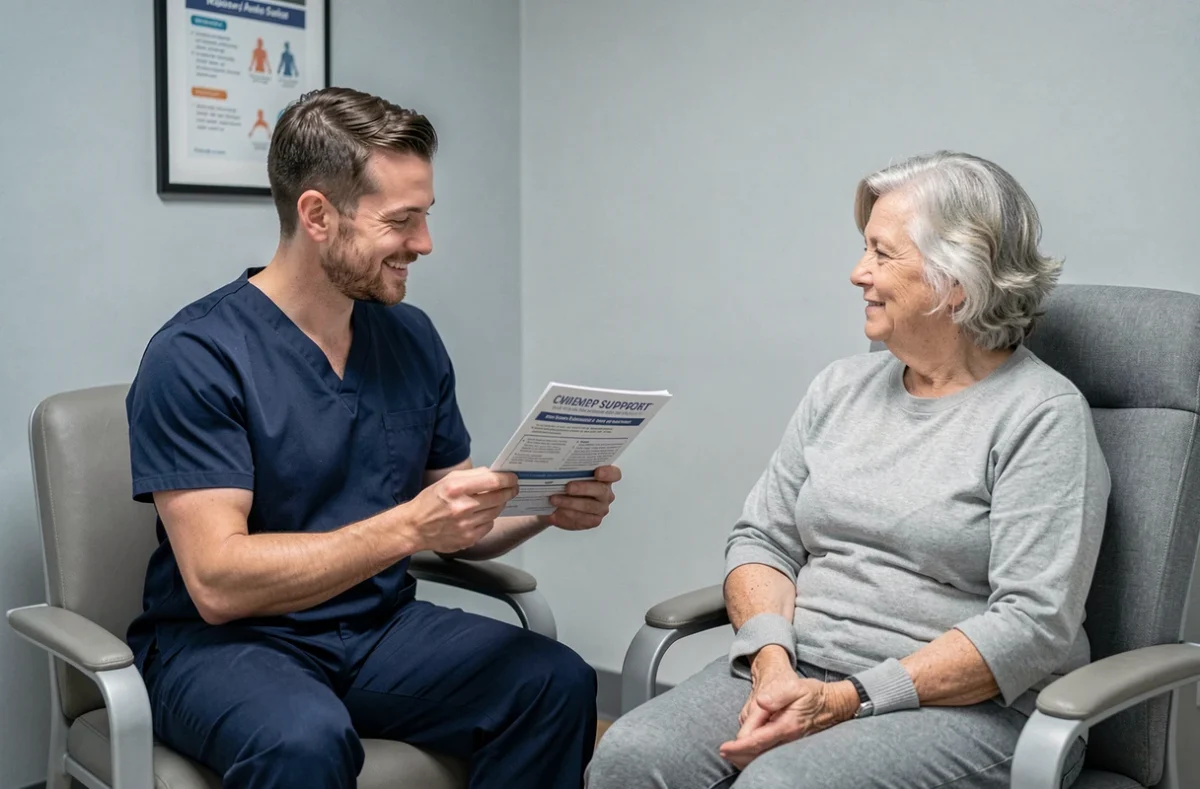
Patient engagement is another consideration. A digital space is only useful if patients access it and understand the documents uploaded. Healthcare professionals who want to help patients make the most of it often lack educational materials suited to their patients’ health literacy levels.
Care networks and CPTSs: coordinating support beyond the practice
Regional professional healthcare communities (CPTS) are the main framework for coordinating independent healthcare professionals within a given area. Their role goes beyond managing health crises. They produce topic-specific resource sheets (mental health, domestic violence, kidney disease, neurodevelopmental disorders) to help practitioners find the right local contacts.
These guides are valuable because they are rooted in the local area. A mental health pathway guide produced by a CPTS lists the services available in the local catchment area, along with observed waiting times and referral procedures. This level of detail is not included in national recommendations.
- For example, the Neuilly-sur-Seine CPTS guides cover geriatric care, adapted physical activity and the identification of domestic violence, with direct contacts and referral protocols.
- Regional coordination platforms make it possible to flag a patient with complex needs and arrange a multidisciplinary case conference without going through a hospital.
- Coordination support services (DAC), created by merging former health networks, centralise requests for support in the most complex cases (multiple conditions, financial hardship, loss of independence).
Accessing these resources requires knowing they exist. Most professionals hear about their CPTS’s tools through word of mouth, due to a lack of structured communication. CPTS websites are poorly indexed and rarely updated consistently.
Quality of care and patient engagement: beyond digital tools
Digital resources address only part of patient support. Quality of care also depends on interpersonal skills that receive little attention in initial training. Active listening, communicating a difficult diagnosis and managing treatment refusal all require skills that can be developed through continuing education.
Some complementary approaches are gaining greater institutional recognition. Animal-assisted therapy, for example, is attracting growing interest in health and social care facilities for its potential to reduce anxiety and encourage communication among patients who respond less well to verbal approaches.
The challenge for healthcare professionals is not to accumulate resources, but to select those that address a clearly identified need in their practice. A general practitioner dealing with social hardship will have different needs from a speech therapist specialising in neurodevelopmental disorders. Targeting resources by clinical issue rather than by tool type remains the most effective way to make a tangible improvement in care.